
A Case Study in AI-Driven Entrepreneurship, Human Governance, and the Real Barriers to Entry
Business: MindTab
Industry: AI-Powered Productivity & Mental Wellness
Business Model: Digital Product / SaaS
Case Study Status: In Progress
Research Question: Can artificial intelligence enable an entrepreneur to build a million-dollar business with minimal experience, capital, and ongoing human involvement?
1. Executive Overview
Artificial intelligence or AI has fundamentally changed the accessibility of entrepreneurship. What once required teams of designers, developers, strategists, researchers, and marketers can now be initiated by a single individual using an increasingly sophisticated collection of AI-powered tools.
Platforms such as MadeThis promote the possibility of building a profitable business quickly, the influencers use words like “make FU money,” in as little as 30 days, even without previous entrepreneurial experience. Or, “Last night I told my AI co-founder to build me a business and I woke up with an operational business”
The proposition is compelling: eliminate traditional barriers to entry, automate business development, and democratize access to opportunities previously reserved for those with significant financial resources or specialized expertise.
However, an important distinction exists between the ability to create a business and the ability to operate a successful one.
This case study follows the development of MindTab, an AI-assisted digital product business, to examine that distinction.
The experiment explores whether AI can meaningfully replace traditional business infrastructure, where human governance and intervention remains necessary, and how much professional experience influences the quality and commercial viability of AI-generated businesses.
Rather than accepting the promise of automated entrepreneurship at face value, this study evaluates the practical requirements of transforming an AI-generated business concept into a sustainable, scalable company.
2. The Experiment: Building MindTab
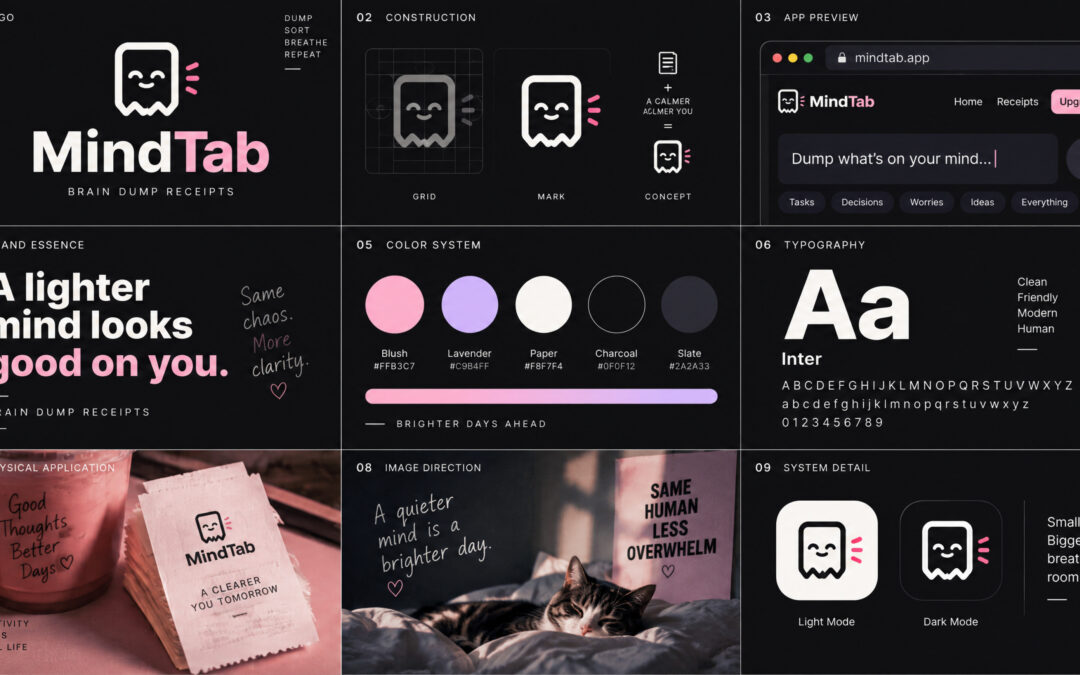
MindTab is positioned as a digital productivity and mental clarity platform designed to help users externalize thoughts, organize mental clutter, and reduce feelings of overwhelm.
Its brand promise, "A lighter mind looks good on you," reflects a consumer-focused approach to mental organization, using accessible language, playful visuals, and emotionally resonant messaging.
The brand identity introduces the concept of "Brain Dump Receipts," framing the experience of unloading mental clutter as something tangible, manageable, and potentially rewarding.
The business serves as the practical subject of an experiment in AI-enabled entrepreneurship.
The objective is not simply to launch MindTab. It is to determine whether the business can achieve $1 million in annual revenue while minimizing the founder's direct operational involvement.
Achieving that objective requires examining multiple dimensions of business development, including product-market fit, technical infrastructure, customer acquisition, financial sustainability, operational automation, and risk management.
The experiment also evaluates the difference between tasks that AI can execute and decisions that require experienced human judgment.
3. The Promise: Entrepreneurship Without Experience
The marketing proposition associated with MadeThis is particularly relevant to this experiment.
The platform is heavily promoted by influencers on platforms like Facebook and presented as an opportunity to build a successful business quickly without previous experience. Most of the influencers use language like “save this video before it gets taken down” and “I probably shouldn’t be sharing this, because then I will have too much competition.”
This claim raises several questions:
- What constitutes a "a silly amount of money, or FU money"? Is the measurement based on revenue, profit, valuation, or projected earning potential?
- Does building a business mean creating a functional product, launching a commercial operation, or demonstrating sustainable customer demand?
- What business responsibilities remain with the founder after the AI-assisted build is complete?
- What level of human expertise is required to recognize and correct AI-generated errors?
- Can the resulting business operate independently, or does it merely transfer the operational workload to the founder?
These distinctions matter because technological accessibility does not automatically translate into commercial viability.
AI can dramatically reduce the cost and time required to produce business assets. It cannot independently establish that customers need those assets, will pay for them, or will continue using them.
A functioning website is not proof of product-market fit. A polished brand is not evidence of demand. An automated workflow is not necessarily a sustainable business operation.
The experiment therefore treats MadeThis as an enabling technology rather than a substitute for business strategy.
Research note: The MadeThis positioning described here is the claim being evaluated, not an independently verified outcome or guarantee.
4. Barriers to Entry: Reduced, Not Eliminated
Historically, launching a technology-based business required substantial resources.
Entrepreneurs frequently needed access to software developers, designers, financial professionals, marketing specialists, legal advisers, and technical infrastructure.
AI has significantly reduced some of these barriers.
An individual can now generate business concepts, develop brand identities, build functional interfaces, draft marketing materials, and automate administrative processes with relatively limited upfront investment.
However, the MindTab experiment identifies a different category of barriers.
4.1 The Knowledge Barrier
AI tools can generate sophisticated outputs without requiring users to understand the underlying disciplines.
This creates an important vulnerability.
An entrepreneur without experience in business strategy, marketing, technology, or financial management may struggle to determine whether an AI-generated recommendation is appropriate, accurate, commercially viable, or legally sound.
The issue is not necessarily the quality of the AI's output. It is the founder's ability to evaluate that output.
For example, AI might recommend a subscription pricing structure without adequately accounting for customer acquisition costs, churn, payment processing fees, ongoing infrastructure expenses, or the competitive landscape.
Without sufficient knowledge, an entrepreneur could implement that recommendation without recognizing its weaknesses.
AI reduces the expertise required to produce an output, but it does not eliminate the expertise required to evaluate its consequences.
4.2 The Technology Integration Barrier
A second challenge emerges when the entrepreneur discovers that no single AI platform performs every business function equally well.
A platform capable of generating an application may not be the most effective tool for market research, brand governance, financial modeling, cybersecurity review, or customer acquisition.
Consequently, the entrepreneur must assemble an ecosystem of specialized technologies.
Each additional platform introduces potential complications involving compatibility, data transfer, recurring costs, security, reliability, and maintenance.
What initially appears to be a simplified business-building process can become a complex exercise in technology orchestration.
4.3 The Financial Barrier
Although AI can reduce development costs, a commercial business still requires investment.
Potential expenses include hosting, software subscriptions, payment processing, advertising, legal documentation, insurance, customer support, and ongoing technical maintenance.
Furthermore, the cost of acquiring customers may substantially exceed the cost of building the product.
A low-cost launch should therefore not be confused with a low-cost path to profitability.
4.4 The Trust and Adoption Barrier
Consumers do not purchase products simply because those products exist.
MindTab must establish credibility, communicate its value, differentiate itself from existing productivity applications, and demonstrate a meaningful benefit to users.
Because the brand operates near the intersection of productivity and emotional wellness, it must also avoid unsupported mental health claims and clearly distinguish organizational assistance from clinical care.
Trust becomes particularly important when a product invites users to share personal thoughts, worries, or emotionally sensitive information.
5. The Multi-AI Requirement: One Business, Several Systems
One of the central hypotheses of this experiment is that building an AI-enabled company requires more than access to a single generative AI platform.
Different systems may be better suited to different functions.
The MindTab experiment therefore considers a multi-AI operating model.
| Business Function | Potential AI Role | Human Responsibility |
| Business strategy | Research, scenarios, positioning | Strategic direction and validation |
| Product development | Code generation, prototyping | Requirements, testing, security oversight |
| Branding | Creative exploration and content | Brand integrity and differentiation |
| Marketing | Campaign generation and optimization | Budget allocation and performance review |
| Financial planning | Forecasts and scenario modeling | Assumption validation and financial controls |
| Customer support | Automated responses and triage | Escalation policies and quality assurance |
| Operations | Workflow automation | Governance, monitoring, and accountability |
The distinction between automation and autonomy is essential.
Automation allows a system to execute defined tasks with reduced human effort.
Autonomy allows a system to make or implement decisions with limited intervention.
A commercially responsible business must determine which decisions can be automated, which require approval, and which should remain under direct human control.
The AI Coordination Problem
The introduction of multiple AI systems creates an additional challenge: coordination.
Different models may generate conflicting recommendations, operate with incomplete context, or optimize for different objectives.
An AI focused on marketing growth might recommend aggressive acquisition spending, while an AI focused on financial sustainability might recommend reducing expenses.
Neither recommendation is inherently correct without a shared understanding of business priorities.
This introduces a need for centralized governance, consistent business data, defined decision-making authority, and documented operating standards.
The entrepreneur does not simply become an AI user. The entrepreneur becomes the director of an AI-powered organization.
6. The Governance Gap
The most significant risk in the promise of experience-free entrepreneurship may be the assumption that execution and governance are interchangeable.
They are not.
An AI system can generate a privacy policy, but that does not establish that the policy accurately describes the company's data practices.
It can produce financial projections, but those projections are only as reliable as their underlying assumptions.
It can build software, but functional software is not automatically secure, accessible, scalable, or compliant with applicable regulations.
It can create compelling marketing messages, but those messages may contain unsupported claims or misrepresent product capabilities.
These examples illustrate why governance must be built into the operating model rather than introduced after problems emerge.
For MindTab, a governance framework should address:
- Strategic governance: Establishing objectives, market positioning, and performance measures.
- Technical governance: Reviewing code quality, integrations, cybersecurity, reliability, and data handling.
- Financial governance: Monitoring revenue, profitability, expenditure, and financial exposure.
- Brand governance: Maintaining consistent messaging, visual standards, and responsible claims.
- AI governance: Defining approved tools, data-sharing boundaries, human review requirements, and accountability.
- Operational governance: Establishing escalation procedures, quality controls, and contingency plans.
Governance is especially important when the stated objective is to minimize founder involvement.
The less frequently a human reviews daily operations, the more important it becomes to establish clear boundaries, monitoring mechanisms, and intervention triggers.
A business that requires minimal founder involvement must be intentionally designed for that outcome.
It cannot simply be automated and left unattended.
7. The Experience Paradox
Perhaps the most important question emerging from this experiment is whether AI actually eliminates the need for entrepreneurial experience or merely makes the absence of that experience less visible.
An experienced strategist may recognize weak positioning, unrealistic forecasts, inconsistent messaging, or inadequate technical planning before those weaknesses become expensive problems.
An inexperienced founder may receive the same AI-generated outputs without recognizing the need for further evaluation.
This creates a paradox.
The more powerful AI becomes at producing professional-looking work, the more difficult it may become for an inexperienced user to distinguish professional quality from professional appearance.
AI may democratize production without equally democratizing judgment.
This does not invalidate the potential of AI-driven entrepreneurship.
Instead, it suggests that business education, critical thinking, and governance remain important even when traditional execution barriers decline.
8. Working Hypothesis
The MindTab experiment begins with the following hypothesis:
Artificial intelligence can significantly reduce the financial, technical, and operational barriers associated with launching a business. However, achieving sustainable commercial success with minimal founder involvement requires strategic governance, coordinated technology systems, validated market demand, and experienced decision-making.
The experiment will test whether a carefully structured AI operating model can progressively reduce human involvement without compromising product quality, customer trust, or financial performance.
9. What the Case Study Will Measure
To move beyond anecdotal observations, the study will track measurable outcomes as MindTab develops.
| Measurement | Purpose |
| Time to launch | Evaluate the speed advantage of AI-assisted development |
| Number of AI systems required | Measure the complexity of the technology ecosystem |
| Founder hours invested | Quantify the actual human workload |
| Direct operating expenses | Measure the true cost of AI-enabled entrepreneurship |
| Revenue and profitability | Evaluate commercial performance |
| Customer acquisition cost | Determine marketing efficiency |
| Customer retention | Assess ongoing product value |
| AI-generated errors and corrections | Evaluate the reliability of AI outputs |
| Human intervention frequency | Measure operational independence |
| Governance incidents | Identify operational, technical, or compliance weaknesses |
These metrics will distinguish between a business that is inexpensive to create and one that is economical to operate.
10. Preliminary Conclusion
The early premise of the MindTab case study challenges the notion that access to AI alone is sufficient to create a successful company.
AI has made entrepreneurship more accessible, but accessibility and sustainability are different outcomes.
The ability to generate a product in days does not eliminate the need to understand customers, manage financial risk, establish competitive differentiation, or maintain operational accountability.
Nor does combining multiple AI platforms automatically create an autonomous business.
The real opportunity may lie in a new entrepreneurial operating model in which human expertise establishes direction, governance, and accountability while AI performs an increasing share of execution.
The objective is not to remove human intelligence from the business.
It is to determine how effectively human intelligence can direct artificial intelligence to build a business that no longer depends on the founder performing every task.
Case study in progress. Findings and conclusions will be updated as MindTab advances through development, launch, market validation, and growth.